May 27, 2026
Norwegian Audiobooks for Language Learners
Find Norwegian audiobooks, choose a suitable narrator and difficulty level, and follow a practical routine with or without the written book.
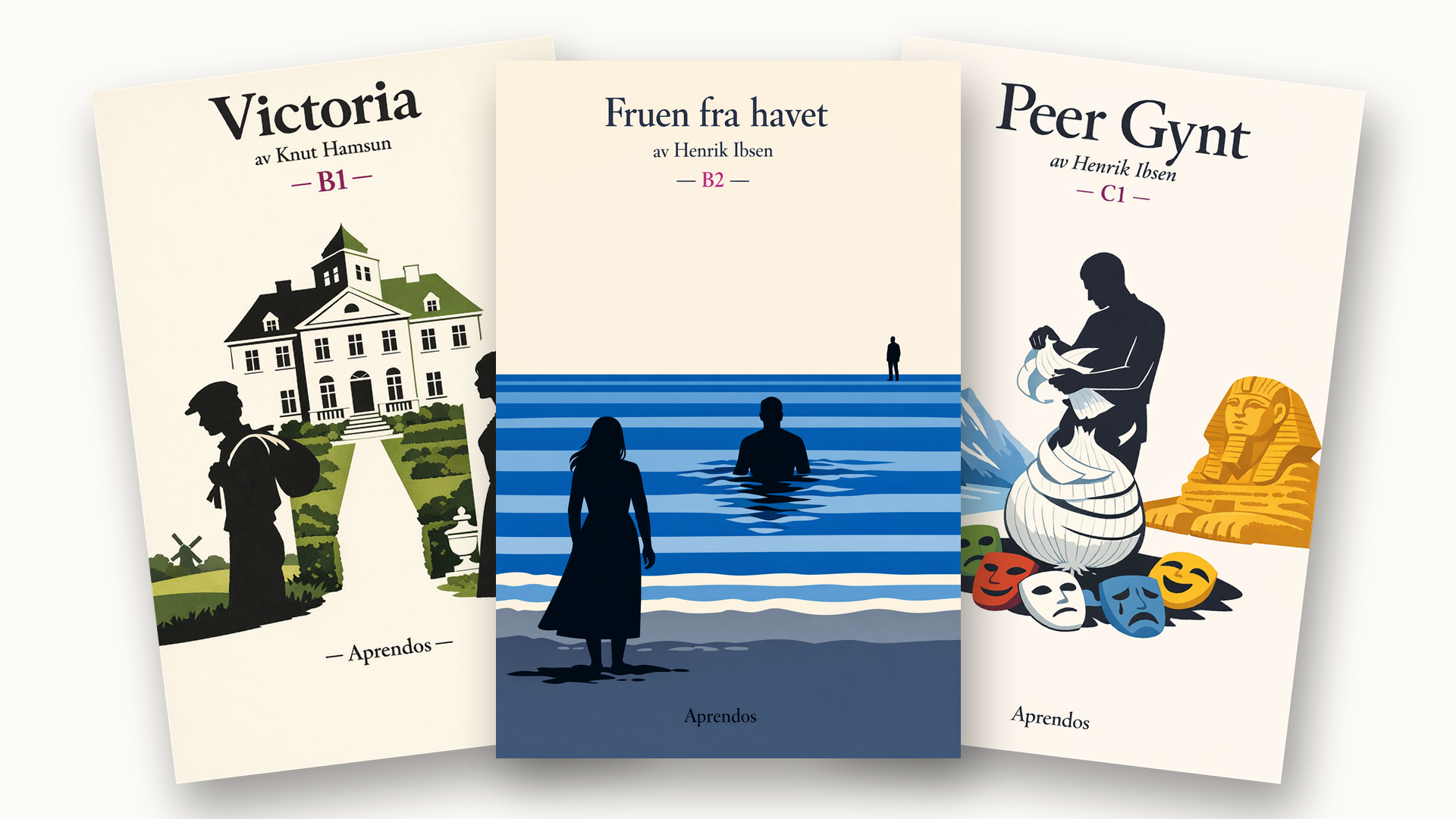
Norwegian audiobooks give language learners something short exercises cannot provide: sustained contact with one narrator, one story and one set of voices over several hours. That continuity can make vocabulary, pronunciation and sentence patterns increasingly familiar.
The difficulty is choosing a book you can learn from. A bestseller with a complex timeline, a highly regional narrator and twenty unfamiliar characters may be enjoyable in translation but exhausting in Norwegian. The most useful first audiobook is not necessarily the easiest book or the most famous one. It is a recording you can follow well enough to continue.
This guide explains where to find Norwegian audiobooks, how to judge their difficulty and how to use the audio with or without the written book.
Where to find Norwegian audiobooks
Availability depends on your country, subscription and local library. Check that a particular title is available in Norwegian before paying for a service. A Norwegian storefront may also contain books narrated in English, Swedish or another language.
Storytel Norway
Storytel Norway offers Norwegian audiobooks and e-books through its app. Its catalogue page lets you inspect current titles, narrators and listening length. Storytel also explains that subscribers can download books for offline listening and, where both formats are available, move between listening and reading.
For language study, search for the title and then check three separate details:
- language: Norwegian
- narrator: one whose sample is clear to you
- formats: audiobook, e-book or both
Do not assume that the audio and e-book are both included merely because the service offers both formats generally. Check the individual title.
BookBeat Norway
BookBeat Norway also provides audiobooks and e-books through its mobile app. Its current plans use monthly listening and reading allowances, and books can be downloaded for offline use. Some new or separately licensed titles may require an additional purchase, so check the lock or price shown on the title page.
BookBeat has categories for fiction, non-fiction, children’s books, young adult books and short stories. Categories are helpful for browsing, but the narrator sample is more useful than the genre label when you are evaluating listening difficulty.
Norwegian public libraries
Learners with an eligible Norwegian library card may be able to borrow digital audiobooks without a commercial subscription. Participating libraries use Biblio, which replaced BookBites in 2026. Bergen Public Library’s Biblio guide explains that its members can borrow Norwegian e-books and audiobooks through the app.
Loan limits, catalogue access and registration requirements depend on the library. Check your own public library rather than assuming that another municipality’s conditions apply to you.
Buying the audio and text separately
Sometimes the best learning combination comes from two sources. You may find the audiobook in a streaming app and the matching printed or electronic book through a bookseller or library.
Confirm that the editions contain the same text. Abridged audio, revised editions and translations can make line-by-line comparison confusing. Matching chapter titles and the opening paragraph is usually enough to detect a mismatch before you begin.
How to choose a Norwegian audiobook at your level
Labels such as beginner, intermediate and advanced are too broad on their own. Test the actual recording.
Choose a familiar subject or story
Prior knowledge reduces the amount of information you must reconstruct from the language. A book about a field you know well can be easier than a linguistically simpler book about an unfamiliar subject.
You can also choose a novel you have already read in another language. Knowing the characters and general plot helps you interpret a missed sentence without consulting a translation after every paragraph.
Listen to the narrator sample
The narrator affects difficulty as much as the author. Before selecting a book, listen to a sample without reading.
Ask yourself:
- Can I identify the topic or situation?
- Can I separate most of the words?
- Does the narrator maintain a pace I can follow?
- Are character voices or sound effects distracting?
- Would I willingly listen to this voice for several hours?
One unclear sentence is not a reason to reject a book. If the entire sample feels like an uninterrupted stream, choose another recording for focused study.
Prefer a manageable structure
Short chapters and a straightforward chronology make it easier to resume after a break. A small cast also reduces the effort spent remembering who is speaking.
Useful first choices often include:
- contemporary stories with a clear sequence of events
- familiar crime, romance or adventure plots
- memoirs about a subject you already understand
- accessible non-fiction divided into short thematic chapters
- short-story collections that let you finish one complete text at a time
Dense literary prose is not bad material. It simply asks you to process style, imagery and unusual vocabulary while you are still learning to recognize ordinary speech.
Do not assume that children’s books are simple
Books for children can have shorter plots and repeated language, but they may also contain rhymes, invented words, exaggerated character voices and references that assume a Norwegian childhood. Young adult or accessible adult fiction may be easier for an adult learner.
Choose from the sample, not from the age category.
A practical guide by level
These are starting points rather than strict CEFR rules.
| Level | A useful starting point | Support to use |
|---|---|---|
| A2 | a familiar children’s or graded story with short chapters | written text, chapter summaries and short listening sections |
| B1 | contemporary fiction with a clear plot or familiar non-fiction | occasional text checks and repeated listening |
| B2 | mainstream fiction, memoir or subject-specific non-fiction | selective vocabulary checks and spoken summaries |
| C1 | literary fiction, complex non-fiction or varied regional voices | targeted checks for nuance, register and cultural references |
At any level, a book is too difficult for focused listening when you repeatedly lose the basic situation even after checking the chapter summary. Save it for later and choose a recording with more familiar language.
If you are unsure about your level, use the CEFR levels guide as a broad reference. Your audiobook choice should reflect your listening ability, which may differ from your reading level.
Test five minutes before choosing the whole book
Use the narrator sample or the beginning of the first chapter.
- Listen once without text or translation.
- State who is present, where the scene occurs and what is happening.
- Listen again and note two or three details.
- Check the written passage or a short summary if available.
- Replay the same section without reading.
The book is a promising choice if the text resolves specific gaps and the final replay sounds clearer. It is probably too difficult if the written passage contains so much unknown language that you must translate nearly every sentence.
Interest matters too. A technically suitable audiobook that you do not want to continue will not supply the sustained exposure that makes the format valuable.
How to use a Norwegian audiobook with the written book
Keeping the text visible for the entire session can turn listening into reading. A better routine uses the written book to diagnose a problem and then removes it.
Work with five to ten minutes of audio.
First: listen for the situation
Listen without reading. Identify the setting, people, main action or central argument. Do not stop for every unfamiliar word.
Second: listen for details
Replay the section. Note important actions, descriptions, reasons or changes. Mark the time of a sentence only when missing it affects your understanding.
Third: check the matching text
Read the difficult passage. Decide what caused the gap:
- an unknown word
- a known word with an unexpected pronunciation
- unclear word boundaries
- a grammatical structure
- a change of speaker
- a cultural reference
Look up only what you need to restore the meaning.
Fourth: close the book and replay
Return to the audio without text. Listen for the words or sound pattern you missed. If the passage is now clear, continue to a new section.
Fifth: give a short summary
Explain the section in Norwegian using two or three sentences. A summary checks whether you followed the message and turns some of the language into active recall.
The slow Norwegian podcast guide explains the same listen, check and replay principle in more detail for shorter recordings.
How to listen without the written book
You do not need a matching text for every audiobook. Once you can follow the plot, listening without text develops your ability to maintain attention and infer meaning across a longer passage.
Use chapter boundaries as checkpoints. At the end of each chapter, record four points:
- who was involved
- what changed
- which detail may matter later
- what you expect to happen next
If you lose the thread, return to the last clear event rather than restarting the entire chapter. A chapter summary, publisher description or familiar-language edition can help you recover the plot, but return to Norwegian audio afterward.
Should you change the playback speed?
A small speed reduction can help you inspect a difficult section, especially when the narrator speaks quickly or changes character voices. Large reductions may distort rhythm and pronunciation.
Start with the original speed. Reduce it only for a passage you cannot resolve, then replay that passage at the original speed. Do not increase the speed merely to finish the book sooner. Comprehension and continued attention matter more than the number of completed hours.
Norwegian varieties and audiobook narration
Norwegian audiobooks expose learners to more variation than a single course recording. A narrator may use regional pronunciation while reading a text written in Bokmål or Nynorsk. Dialogue may also represent a character’s dialect or social background.
You do not need to imitate every feature. First identify what remains stable:
- the meaning of the sentence
- the written form used in the book
- recurring pronunciation patterns from the narrator
- forms that belong to a particular character or region
If variation repeatedly blocks the story, use a different narrator for your first full audiobook. Return to more varied voices after the listening process feels manageable.
What vocabulary should you save?
An audiobook can produce hundreds of unfamiliar words. Saving all of them creates a review burden and interrupts the story.
Keep a phrase when it meets at least one of these conditions:
- it appears repeatedly
- it blocked an important part of the message
- it expresses an idea you expect to use
- it contains a sound pattern you failed to recognize
Save the short phrase or sentence, not only the isolated word. Record the chapter or timestamp so you can hear it again. Review a small selection after the listening session.
For a broader review method, see spaced repetition for language learning.
Audiobook, podcast or graded audio?
Each format develops a different part of listening.
| Format | Best for | Main limitation |
|---|---|---|
| audiobook | sustained narrative, one narrator and vocabulary in extended context | long commitment and potentially literary language |
| podcast | shorter topics, conversational formats and a wider range of speakers | episodes may assume background knowledge |
| graded audio | controlled difficulty, transcripts and focused comprehension practice | less exposure to the length and complexity of a complete book |
You do not need to choose only one. Use an audiobook as the continuing project and shorter material for targeted listening. Aprendos provides Norwegian listening practice and level-based material in the Norwegian library.
A two-week first-audiobook plan
Choose one short book or commit to its first three chapters.
Days 1 to 3
Work with five minutes a day. Use the written text after the first two listens and note which problems recur.
Days 4 to 7
Increase to ten or fifteen minutes. Check only passages that affect the plot or argument. Give a spoken summary after each session.
Days 8 to 10
Listen to one section without opening the written book. Use the next session to verify only the details you remain unsure about.
Days 11 to 14
Complete a chapter at the original speed. Compare your first-listen understanding with the beginning of the plan. Decide whether to continue the book, change the narrator or choose a simpler title.
Progress is not finishing a certain number of pages. It is following more of a new passage with less support.
Common mistakes
Choosing by popularity alone
A popular Norwegian title may still be unsuitable for your current listening level. Test the narrator and language before committing.
Reading a translation during the audio
A translation can preserve the plot while your attention leaves the Norwegian. Use it between listening attempts only when you need to recover the broader context.
Stopping for every unknown word
Constant interruption prevents you from following relationships across sentences. Finish the short section first, then investigate the few gaps that matter.
Continuing a book you cannot follow
Abandoning one unsuitable audiobook is not failure. The recording may become useful later. A better match now will provide more productive listening time.
Frequently asked questions
Where can I find Norwegian audiobooks?
Storytel and BookBeat have Norwegian audiobook catalogues. Eligible Norwegian library members may also have access through Biblio. Availability, prices and loan conditions can change, so check the current title and terms directly.
Should I read while listening?
Use the written book selectively. Listen first, read the passage that caused difficulty, and replay it without looking at the text.
Are children’s audiobooks easier?
Sometimes, but not automatically. Preview the vocabulary, narrator and character voices. A familiar contemporary novel may be easier for an adult learner.
Should I choose Bokmål or Nynorsk?
Choose the written form relevant to your goals, but check the narrator as well. The spoken variety is not determined solely by the written standard shown on the book page.
How long should I listen each day?
Ten focused minutes with recall and selective checking can be more useful than an hour of distracted listening. Increase the duration when you can maintain the thread of the story.
Choose one title, test five minutes and keep the book only if the final replay becomes clearer. The right Norwegian audiobook should stretch your listening without making the story disappear.