June 1, 2026
Slow Norwegian Podcast: How to Reach Normal Speed
Use slow Norwegian audio, transcripts, repeated listening, and controlled speed changes to understand more natural speech without remaining dependent on slow recordings.
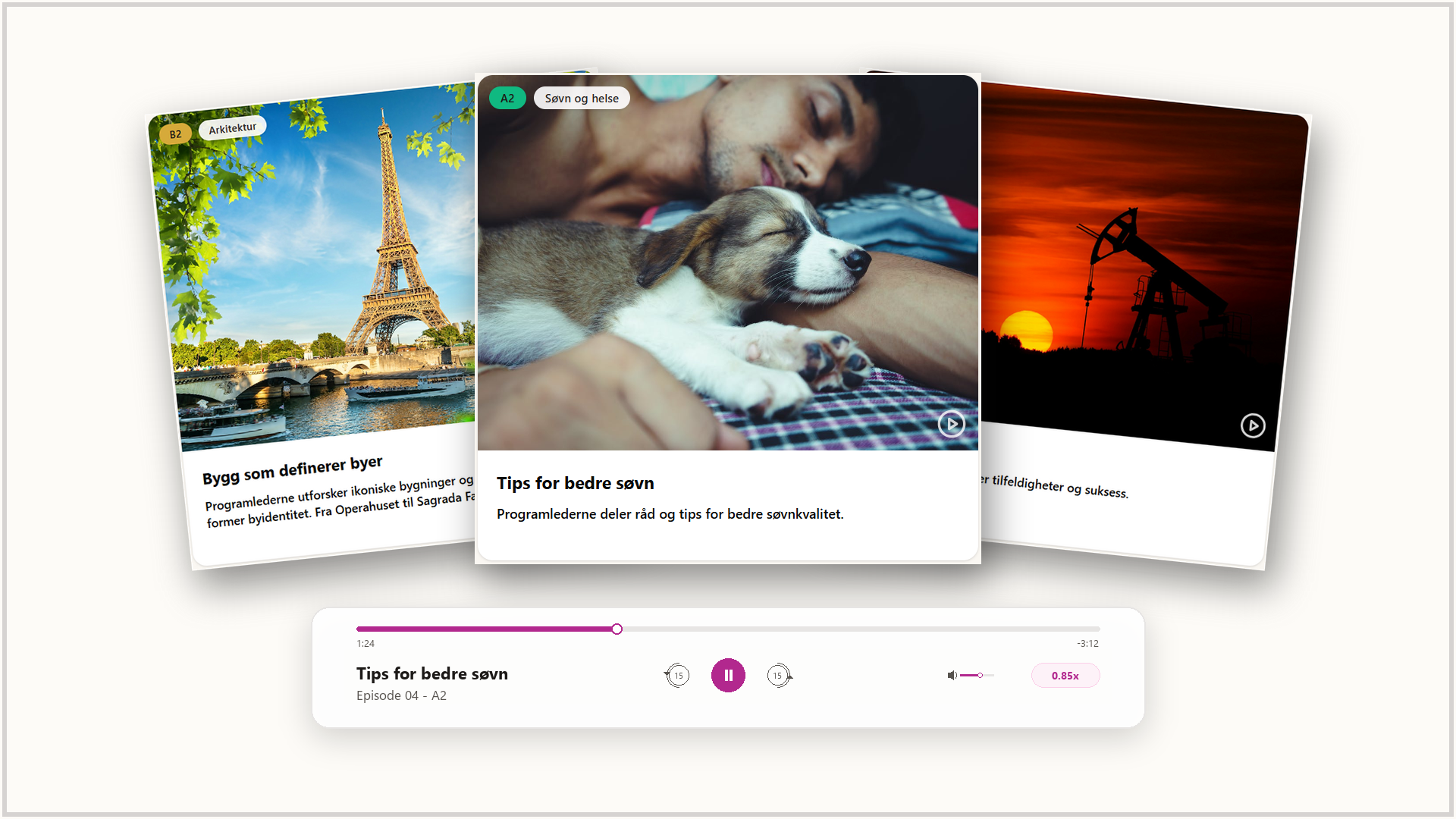
A slow Norwegian podcast can make spoken Norwegian understandable enough to study. It gives you more time to identify words, follow sentence structure, and connect sounds with meanings. The purpose is not to stay with slow audio. It is to build the listening skills needed for ordinary conversations, radio, meetings, and other normal-speed speech.
Useful slow audio keeps natural pronunciation and phrasing while reducing the processing load. Artificially stretched audio can distort sounds. Recordings made for learners are often better because the speaker can use a moderate pace, clear topic structure, and controlled vocabulary without changing the language into a sequence of isolated words.
Why spoken Norwegian can be difficult
Knowing a written word does not guarantee that you will recognize it in speech. Spoken language arrives continuously. Sounds influence one another, unstressed syllables become less prominent, and word boundaries may be hard to hear.
Norwegian adds several practical challenges:
- written Bokmål does not represent one uniform spoken variety
- speakers use regional pronunciation and local vocabulary
- common words may be reduced in connected speech
- pitch patterns can affect how phrases are perceived
- a familiar word may sound different from the form imagined from spelling
This does not mean that every learner must study every dialect. Begin with one variety that matches your course, location, or personal needs. Add other speakers after you can follow the main message consistently.
What slow audio should do
Slow audio is useful when it gives you enough time to process a message that would otherwise be lost. It should still sound like connected Norwegian.
A useful recording has:
- a clear topic
- natural sentence stress
- complete phrases rather than isolated words
- enough familiar vocabulary to follow the main point
- a transcript or reliable support for difficult sections
- audio quality that makes consonants and vowels clear
If a recording is slow but most of the vocabulary and grammar are unknown, speed is not the main difficulty. Choose easier material or preview the topic first.
What research says about speech rate
Slower speech can improve comprehension in some listening conditions, but slower is not always better. A study of different training conditions found that learners trained with slow recordings performed well, while pause controls and learner-selected speed developed somewhat different listening strategies. The details are available in McBride's study of speech rate and distributed listening practice.
Research with younger learners also found that a moderately slower rate improved comprehension, while a much slower rate did not produce the same benefit. See the 2023 study of speech rate and listening comprehension.
The practical lesson is not to search for one correct speed. Use speed as one form of support. The recording should remain natural enough that what you learn can transfer to ordinary speech.
Slow recording or reduced playback speed
These options are not identical.
A slow recording is produced at a moderate pace. The speaker can keep normal pitch, emphasis, pauses, and articulation. This is usually the better starting point for focused learning.
Reduced playback speed modifies an existing recording. It can help you inspect a short difficult section, but large reductions may sound distorted. Use it selectively and return to the original speed before finishing.
If the podcast supplies both learner-speed and normal-speed versions, use both. Begin with the version that makes the message accessible, then test whether the same words can be recognized at the natural rate.
A five-step method for a slow Norwegian podcast
Use a short section of two to five minutes. Working with a whole long episode makes it difficult to locate the reason for a comprehension gap.
1. Listen for the main message
Listen once without the transcript. Do not pause for every unknown word. At the end, answer Who or what was the section about? and What was the main point?
If you cannot answer either question, add support before repeating. Read the title, review a short description, or choose an easier section.
2. Recall important details
Listen again and note people, places, actions, reasons, or opinions. Write only after the section ends so note-taking does not replace listening.
Use questions such as What happened first?, Why did the speaker make that decision?, or Which example supported the main point?
3. Check the transcript
Read the transcript while replaying the sections you missed. Mark only the gaps that affected understanding.
Check whether the difficulty came from:
- an unknown word
- a known word that sounded unfamiliar
- a reduced or connected form
- an unfamiliar grammatical pattern
- a dialect feature
- lost attention
This diagnosis determines the next action. A vocabulary gap needs a meaning check. A sound-recognition gap needs comparison between the recording and transcript.
4. Replay without the transcript
Close the text and listen again. The aim is to hear the words you identified, not merely remember what the transcript said.
Pause after one sentence and reconstruct it when the sound pattern remains unclear. Then replay the original and compare pronunciation, stress, and word order.
5. Test a faster version
If the recording has a normal-speed version, listen to it. Otherwise, increase playback speed in a small step. Do not move directly from a heavily reduced speed to a setting you cannot follow.
End by stating the main message again. If you understand the normal-speed version only because you memorized the passage, test the same method with a new section on a similar topic.
How to change playback speed
Start at the fastest setting that lets you follow the main message. For one difficult sentence, reduce the speed and compare it with the transcript. Then increase the setting again.
A practical sequence might move from 0.8 to 0.9 and then to the original speed. These numbers are examples, not fixed stages. Some recordings need no speed reduction. Others are unsuitable even when slowed because the vocabulary, dialect, or audio quality creates the main difficulty.
Change one variable at a time. If you reduce the speed, add subtitles, read a translation, and study a vocabulary list simultaneously, you will not know which support helped.
How to use a transcript without becoming dependent on it
Transcripts are useful when they explain a listening failure. They become a problem when you read from the beginning and never test the audio alone.
With a longer episode, a transcript synced by paragraph or sentence helps you find the exact passage without scanning the whole page. Treat synchronization as navigation support. Listen first, open the matching passage only when necessary, and close it before replaying.
Use this order:
- Listen without text. Identify the main idea and any details you can follow.
- Read only the difficult section. Match the spelling with the sound.
- Close the transcript. Replay the same section and retrieve what you heard.
- Listen to a new section. Check whether the same sound pattern is easier to recognize.
Do not translate the full transcript unless translation is the task. A short meaning check is often enough to restore comprehension.
A one-week progression
Use several short recordings from the same speaker or series. Familiarity with the voice and format reduces unnecessary difficulty while you build the listening process.
Days 1 and 2
Work with learner-speed audio and a transcript. Focus on the main message, important details, and missed word boundaries.
Days 3 and 4
Replay selected sections at a slightly faster setting. Reconstruct one or two sentences and give a short spoken summary.
Days 5 and 6
Use a new section from the same series. Delay opening the transcript and try the original speed after the first supported attempt.
Day 7
Choose an unfamiliar short recording on a related topic. Record what you understand on the first attempt. Compare it with your result from the beginning of the week.
Progress means understanding more without support. It does not mean forcing every recording to normal speed by a deadline.
Common mistakes
Staying with very slow audio
Slow audio can become comfortable. Include regular tests with normal-speed sections so you know whether the skill is transferring.
Increasing speed before understanding
Faster playback is not progress when the message disappears. First resolve the important vocabulary, grammar, or sound gaps. Then increase speed.
Studying only one speaker
One voice helps during early practice, but real listening requires variation. Add speakers gradually, beginning with the variety most relevant to you.
Treating dialect as bad pronunciation
Norwegian speech varies by region and context. Record the form you heard, identify where it is used when possible, and compare it with the written form without labeling ordinary variation as an error.
Saving every unknown word
Most recordings contain low-value details. Save recurring expressions, words that block the main message, and phrases you expect to use. Keep the review list small.
Choosing a slow Norwegian podcast
Before committing to a series, test one episode. Check whether you can identify the topic after one listen and whether the transcript matches the recording accurately.
Prefer a series that provides:
- consistent audio quality
- clear episode descriptions
- transcripts or structured notes
- topics relevant to your goals
- more than one difficulty level or playback option
- access to normal-speed Norwegian
The Norwegian podcast guide can help you compare broader podcast options. Choose one main series for focused practice and use other material for variety.
How Aprendos supports the progression
Aprendos is designed for learners from A2 to C1. Norwegian lessons combine level-based audio with transcripts, comprehension and language exercises, graded reading, and review. These supports let learners work first on meaning, then inspect missed sections, and finally return to the audio without the transcript.
The Aprendos audio player includes a speedometer control with 1x, 0.75x, and 0.5x playback. Learners can slow a difficult section, compare it with the transcript, and then return to 1x speed when the message is clear. This makes speed a support the learner can adjust for each recording rather than a permanent setting applied to every lesson.
The platform cannot choose one ideal playback speed for every learner. Topic knowledge, dialect familiarity, vocabulary, and the recording itself change the difficulty. Use comprehension checks to decide when to reduce support or move to a faster version.
The rule to remember
Use slow Norwegian audio to make the message understandable, identify why normal speech is difficult, and practice the same listening process with gradually less support. Keep natural pronunciation, use transcripts after the first attempt, and test new material at normal speed regularly.