September 16, 2026
How to Use Shadowing to Improve Your Spanish
Learn how to choose suitable Spanish audio, build from phrase shadowing to continuous speech, diagnose problems, and measure progress.
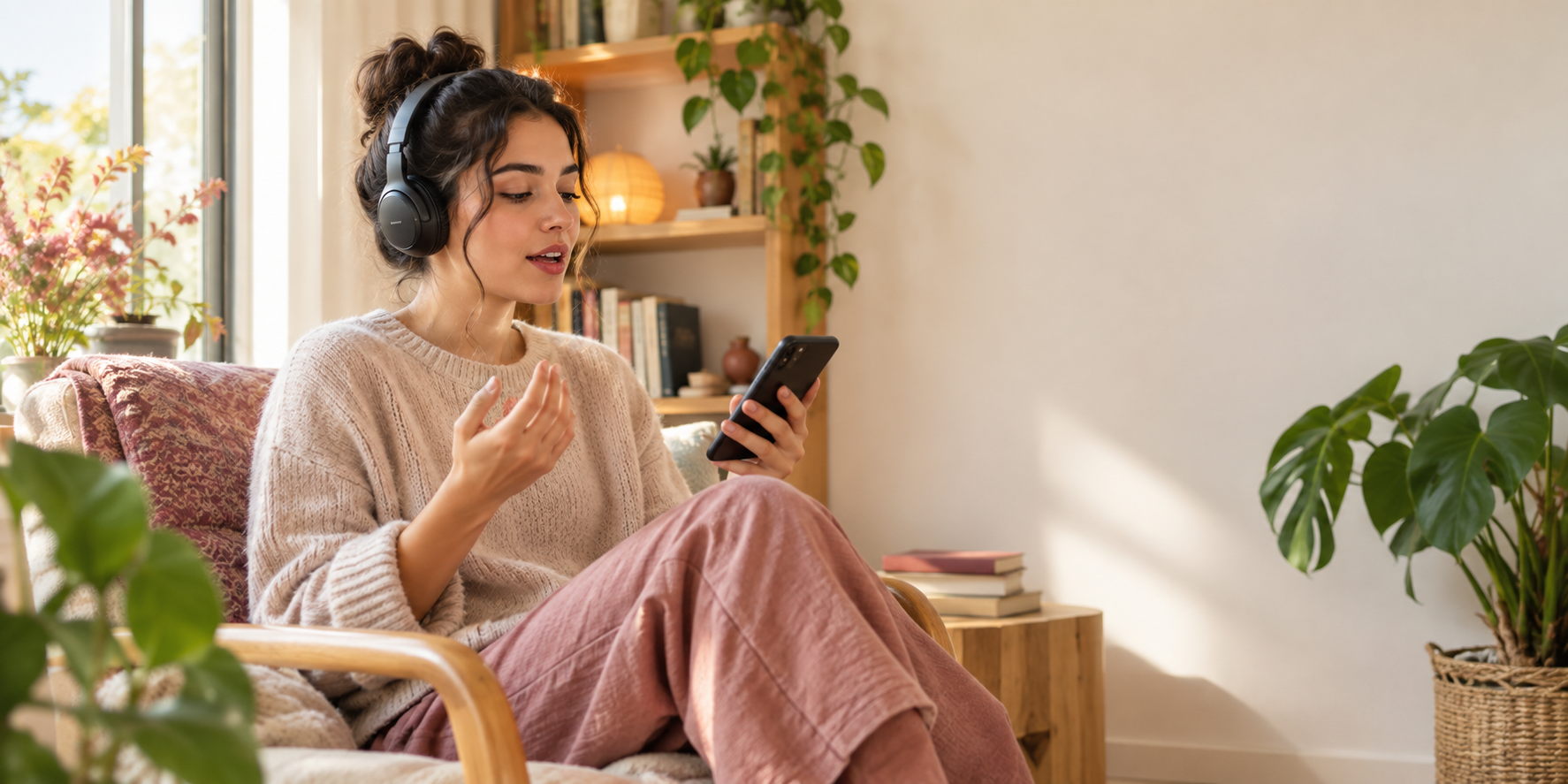
Shadowing is a demanding listening and speaking exercise. You repeat a Spanish speaker while the recording continues, following a fraction of a second behind. The task forces you to hear where words begin, how syllables receive stress, which sounds connect, and how a complete phrase moves.
The method works best as a short, staged exercise. Starting immediately with a fast two-minute recording usually produces hurried speech and weak attention. A passage of 20 to 40 seconds gives you enough language to study closely and enough repetition to hear change.
This guide shows you how to choose a useful recording, prepare it, shadow it in four stages, and check whether the practice transfers to new Spanish. For broader listening diagnosis, begin with the Spanish listening practice guide. The Spanish pronunciation guide covers individual sounds, stress and intonation in greater detail.
What shadowing trains
In ordinary listen-and-repeat practice, the recording stops before you speak. Shadowing keeps the recording playing. You must hold a short piece of speech in memory while listening to the next one and producing the previous one.
That combination can train several processes:
- noticing sound sequences inside continuous speech
- maintaining attention through a complete phrase
- reproducing word stress and sentence rhythm
- coordinating listening with speech production
- keeping a steady pace without planning every word separately
Research supports a careful interpretation of these benefits. A 2016 study of shadowing and listening comprehension found improved phoneme perception in both proficiency groups it examined, while gains on one listening measure appeared only in the lower-proficiency group. A 2025 systematic review of shadowing for pronunciation found promising evidence for comprehensibility, intelligibility, fluency and prosody, alongside methodological limitations across the research base.
Most shadowing research has examined English and other second-language settings. Applying the method to Spanish is a reasonable practical extension, although claims about guaranteed Spanish-specific results would exceed the evidence. Treat shadowing as one focused component of a wider learning routine.
Choose audio that fits the exercise
The right recording allows you to pay attention to sound and meaning at the same time. Select a passage that meets these conditions:
- one main speaker
- 20 to 40 seconds of continuous speech
- clear recording quality
- natural delivery at a manageable speed
- an accurate transcript
- familiar topic and mostly familiar vocabulary
- a regional variety you want to understand or produce
Aim to understand the main message before opening the transcript. If the passage remains incomprehensible after two listens, choose easier material. If every word is obvious and the rhythm presents no challenge, choose a slightly harder passage.
Scripted learner audio is useful while you learn the procedure. Unscripted speech introduces hesitations, reductions, interruptions and less predictable phrasing. A study comparing scripted and unscripted Spanish listening texts illustrates why authentic speech presents a different comprehension demand. Add it when you can maintain the shadowing sequence with clearer material.
Choose speech you may eventually use. A passage about arranging a meeting, explaining a delay, describing a place or giving an opinion provides phrases that can return in conversation. Random sentences make transfer harder to observe.
Establish meaning before speaking
Listen twice before your first spoken attempt.
On the first listen, identify the situation and main point. On the second, note two or three details and mark any section that disappears into a blur. Then open the transcript and resolve the difficult section.
Read the passage once for meaning. Mark phrase boundaries with slashes and underline the words that carry the main stress:
Cuando termine la reunión / te mando el documento / y hablamos mañana.
“When the meeting finishes, I’ll send you the document and we’ll talk tomorrow.”
The marks provide a map for listening. Play the sentence again and adjust them according to the speaker’s delivery. Written punctuation can suggest a boundary, but the recording determines the spoken grouping.
Check unknown language at this stage. Shadowing a sequence you cannot interpret may improve your ability to copy its surface, yet it gives you little basis for using the language independently.
Build through four shadowing stages
Stage 1: phrase shadowing
Divide the passage into phrases lasting two to five seconds. Play one phrase, pause, and reproduce it. Keep the meaning in mind and copy the strongest stress, the main pitch movement and the way words connect.
Record one attempt. Compare only one feature at a time. You might check whether the final vowel remains clear, whether the stressed syllable falls in the correct place, or whether a phrase sounds like one unit.
Phrase shadowing prepares the material without the pressure of simultaneous listening and speaking.
Stage 2: delayed shadowing
Play the full passage and begin repeating after a delay of roughly one short phrase. Keep the transcript visible for the first attempt. Follow the speaker continuously, allowing each phrase to enter memory before you produce it.
If you lose the sequence, rejoin at the next marked boundary. Avoid racing through omitted words to catch up. A clean restart preserves rhythm and gives you a useful point for diagnosis.
Reduce the delay as the passage becomes familiar. Use enough distance to hear the phrase while maintaining the pressure to keep listening as you speak.
Stage 3: close shadowing
Close the transcript and follow just behind the speaker. Copy the whole phrase and let individual syllables remain inside it. Keep your volume low enough to hear the source clearly.
Complete three rounds with different priorities:
- Follow every phrase boundary and preserve the message.
- Copy stress, rhythm and linking.
- Copy intonation and communicative intention.
Three purposeful rounds provide more information than ten identical repetitions. Stop when fatigue causes your articulation or attention to deteriorate.
Stage 4: independent reconstruction
Turn off the recording and explain the same message in your own words. Then use one or two phrases from the passage in a new situation.
Suppose the source includes:
Al final decidimos aplazarlo hasta la semana que viene.
“In the end, we decided to postpone it until next week.”
You could transfer the pattern into:
Al final decidimos cambiar el lugar de la reunión.
“In the end, we decided to change the meeting location.”
This final stage checks whether the practice has become available for communication. It also prevents familiarity with one recording from being mistaken for broader progress.
Follow a 15-minute shadowing session
| Time | Task | Evidence to collect |
|---|---|---|
| minutes 1 to 3 | listen twice and identify the message | a one-sentence summary and two details |
| minutes 4 to 6 | check the transcript and mark phrase boundaries | corrected words and one sound problem |
| minutes 7 to 9 | complete phrase and delayed shadowing | one recorded attempt |
| minutes 10 to 12 | complete three close-shadowing rounds | fewer omissions or steadier phrasing |
| minutes 13 to 15 | reconstruct and transfer | a new spoken example |
Use the same passage for two or three sessions. On the second day, spend less time with the transcript and more time on reconstruction. On the third, shadow a new passage from the same speaker or topic and check whether the improvement carries over.
Focus on Spanish rhythm and connections
Spanish learners often hear familiar words too late because the spoken sequence differs from the isolated forms stored in memory. Shadowing helps you attend to the sequence as it occurs.
Listen for these features:
Stable vowels
Spanish vowels usually remain clearer than unstressed English vowels. Copy words inside phrases so the vowel stays recognizable while speed increases.
Word stress
Mark the stressed syllable in unfamiliar words and then return the word to its phrase. Stress can distinguish forms such as termino, término and terminó.
Connections across words
A final consonant may connect closely to the following vowel. Adjacent vowels can also form a smooth sequence. Shadow the complete group so spelling does not impose artificial pauses.
Meaningful prominence
Speakers give greater prominence to the information they contrast, correct or introduce. Copying every syllable with equal force removes part of the message.
Intonation
Copy the rise, fall or continuation pattern that expresses the speaker’s intention. Use a request, correction, reaction or conclusion so the intonation carries a clear purpose.
Choose one feature for each session. A narrow focus makes comparison possible and keeps the exercise from turning into vague imitation.
Adjust the method to your level
| Level | Passage | Recommended form |
|---|---|---|
| A2 | 10 to 20 seconds, familiar topic, clear speaker | phrase shadowing followed by a generous delay |
| B1 | 20 to 30 seconds, mostly familiar vocabulary | delayed shadowing followed by short close-shadowing rounds |
| B2 | 30 to 45 seconds, natural connected speech | close shadowing plus independent reconstruction |
| C1 | 30 to 60 seconds, varied speakers and registers | selective shadowing of difficult passages plus spontaneous response |
At A2, accuracy and comprehension deserve more attention than speed. At B1, the main challenge is often maintaining a phrase while the next one arrives. B2 and C1 learners can work with reductions, regional variation, faster turns and denser information.
The B1 Spanish listening plan provides a broader weekly structure for learners at that level.
Diagnose common shadowing problems
You lose the speaker after a few seconds
Shorten the passage and increase the delay. Mark two reliable re-entry points. Practise each phrase separately before joining them.
Your speech becomes a mumble
Return to phrase shadowing and reduce the speed. Check whether the obstacle is an unknown word, an unstable sound or excessive tension. Clear production at a slower pace gives you a stronger base for acceleration.
You can copy the sounds without understanding
Pause after every round and state the message from memory. Ask yourself who did what, why it mattered and what happened next. Choose easier input when those answers remain unavailable.
You depend on the transcript
Use the text during preparation, then cover one line at a time. Complete the final rounds with the transcript closed. A transcript should solve a listening problem and then leave the task.
One passage sounds excellent, while new audio remains difficult
You have learned the passage. Add a second recording from the same speaker and topic, followed by a third from a different speaker. Transfer appears when the skill survives unfamiliar wording.
Your voice hides the source
Lower your volume, use one earbud, or play the audio through a speaker. Hearing the model throughout the exercise is essential.
Measure progress beyond one recording
Save your first phrase-shadowing attempt and your final close-shadowing attempt. Compare them using a short checklist:
- number of omitted or changed words
- ability to rejoin after losing the sequence
- consistency of phrase boundaries
- accuracy of word stress
- clarity of connected speech
- ability to summarize the message afterward
Then use unfamiliar audio of similar difficulty. Listen once and record the main idea and details. Shadow it after minimal preparation. Improvement on new material provides stronger evidence than a polished performance of the original passage.
You can also record an independent response to the topic. Check whether a phrase, rhythm pattern or pronunciation feature from the shadowing passage appears naturally. That is the bridge between controlled practice and conversation.
Build shadowing into a complete lesson
Shadowing needs a clear place inside the learning sequence. Begin with comprehension, investigate a short difficult passage, shadow it, retrieve useful expressions, and finish with an independent response. Reading, vocabulary and grammar work can remain connected to the same topic.
On Aprendos, each Spanish lesson begins with a native-audio episode and develops the same topic through listening, vocabulary, grammar, reading and speaking activities. Choose a 20-to-40-second section from the episode for shadowing, then complete the related activities and respond to the episode’s main question.
Choose a Spanish episode and try the sequence.
Shadowing becomes useful when every repetition has a purpose. Prepare the meaning, build from phrases to continuous speech, focus on one feature, and finish with language of your own. Ten concentrated minutes can reveal more about your listening and pronunciation than a long session of passive replay.