May 27, 2026
Spaced Repetition Without Flashcards: A Practical System
Build a simple review system for listening clips, passages, corrections, speaking prompts, and writing tasks without maintaining a flashcard deck.
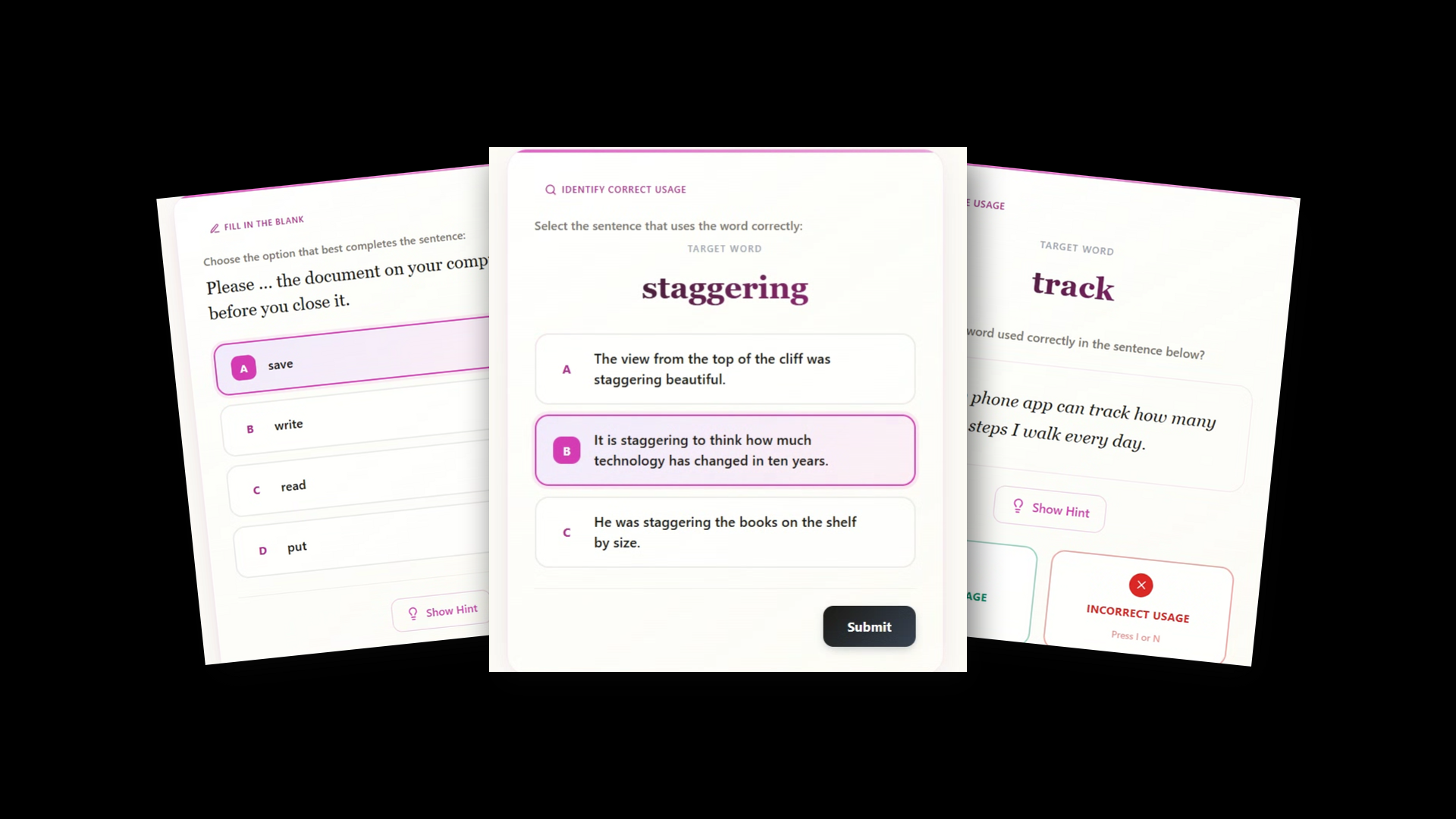
You do not need a flashcard deck to use spaced repetition. You need something worth remembering, a task that tests it, a delay before the task returns, and a decision about when to review it again.
The review unit can be a ten-second audio clip, a corrected sentence, a paragraph, a speaking question, or a short writing task. In each case, the principle is the same: attempt the task from memory, check the result, and schedule the next attempt according to how well you performed.
This article is about building that system without cards. For the research on distributed practice, the difference between spacing and active recall, and the reasons intervals should change, read Spaced Repetition for Language Learning: How It Works.
What counts as spaced repetition without flashcards
A review counts when the same knowledge or skill returns after a delay. The material does not need to appear in a question-and-answer card.
These are valid examples:
- listening again to a saved clip and stating its meaning before checking the transcript
- returning to a short article and reconstructing its main argument before rereading
- correcting a sentence that contains the same error you made last week
- answering the same speaking prompt with fewer notes and different details
- rewriting a message while applying a correction from an earlier draft
These activities use spacing because the return is planned. They use retrieval when you try to understand, explain, or produce something before seeing the answer.
Opening the same text every day and reading it from top to bottom is scheduled exposure, but it is a weak memory check. Playing an old podcast in the background is also not a reliable review if you never test what you recognize. A no-card system still needs an explicit task and a way to check the result.
The minimum system: material, task, date, result
Do not build a complicated database before completing your first review. A note, spreadsheet, paper notebook, or calendar can manage a small system.
Record four things:
| Field | What to write | Example |
|---|---|---|
| material | a precise item you can find again | episode 12, 04:10 to 04:28 |
| task | what you must do before checking | explain the speaker's objection |
| next review | one date, not a vague intention | 18 September |
| result | a short performance label | partial: meaning clear, verb ending missed |
The task is the most important field. “Review episode 12” leaves too many options. “Listen once and explain why the guest disagrees” defines what success looks like.
Use three result labels:
- secure: You completed the important part accurately without help.
- partial: You understood or produced the central answer but missed a relevant detail or needed a cue.
- missed: You could not retrieve the answer or your answer changed the intended meaning.
After a secure result, increase the delay. After a partial result, use a shorter delay. After a missed result, correct the problem first and bring the task back soon. The main spaced-repetition guide gives a simple starting schedule, but the exact dates matter less than responding consistently to performance.
System 1: a listening clip queue
Save short clips that contain a useful phrase, a difficult word boundary, an unfamiliar voice, or a detail you failed to understand. A complete podcast episode is usually too large for one review item because a single result cannot describe performance across thirty minutes.
For each clip, write one listening task. Suitable tasks include:
- state the main message after one listen
- write the exact phrase surrounding a target word
- identify who or what a pronoun refers to
- explain the speaker's attitude and cite the words that indicate it
- repeat one sentence while preserving its stress and timing
On the first review, play the clip once without text and complete the task. Then check the transcript or answer evidence. Identify the source of any error: an unknown word, a missed sound, an incorrect word boundary, a grammar form, or a mistaken inference.
Do not repeat the clip continuously until it feels familiar. Once the problem is understood, schedule a later return. Familiarity immediately after correction is not evidence that the sound will be recognized next week.
Change the final review slightly. If the original task was transcription, finish by explaining the meaning. If the original task was comprehension, try to reconstruct one important sentence. This checks whether the clip has become useful language rather than a memorized piece of audio.
System 2: saved passages with reconstruction
A passage can hold vocabulary, grammar, and argument structure together. Keep it short enough that you can review it in a few minutes: one paragraph, a scene from a graded reader, or a brief section of an article.
Before rereading, use one reconstruction task:
- list the three main events in order
- retell the paragraph without looking
- complete a copied version with selected phrases removed
- explain why the author used a particular tense or connector
- rewrite the passage from another person's perspective
Then open the original and compare. Mark only differences that affect the learning target. If the goal was narrative order, a synonym may be acceptable. If the goal was a past-tense contrast, changing the tense is important.
Avoid trying to reproduce an entire paragraph word for word unless exact wording is necessary. Verbatim recall can turn a rich text into one enormous flashcard and may reward memorization without flexible use.
A good later review changes one condition. Retell the same event in another time frame, replace the location, or explain the argument to a different audience. The source remains familiar, but the task now tests whether you can transfer its language.
System 3: a correction log
Corrections from speaking and writing are valuable review material because they come from language you tried to use. The original communicative need is already known.
Do not save every correction. Keep recurring errors, errors that changed the meaning, and forms you expect to need again. Record:
- the original sentence
- the corrected sentence
- a short reason for the change
- a new situation that requires the same pattern
Suppose you wrote Depende de si tendré tiempo and the correction is Depende de si tengo tiempo. On the next review, do not simply copy the corrected sentence. Use the pattern with a different subject: Depende de si ella puede venir. A later review might require a spoken answer beginning with depende de si.
This approach separates a useful pattern from one memorized sentence. It also makes the result easier to judge. If the same error appears in the new context, the pattern is not secure and should return sooner.
Review the log by due date, not from the first page every time. Archive entries that remain accurate across several varied attempts. A correction log should become smaller as control improves.
System 4: recurring speaking prompts
Spoken fluency requires more than remembering a prepared script. A useful speaking item keeps the communicative purpose stable while changing the wording or details.
Choose a prompt you are likely to encounter:
- explain a recent decision
- describe a problem and propose a solution
- disagree politely with a suggestion
- compare two options and recommend one
- summarize something you heard or read
Record a first response lasting 30 to 90 seconds. Note one or two targets, such as using past tenses accurately, giving reasons with clear connectors, or reducing long pauses around a particular phrase.
When the prompt returns, answer it again without replaying the previous recording first. Change at least one detail so you cannot recite the same response. Compare the new attempt with the targets, not with an imagined native-speaker performance.
A secure result means the target language appeared accurately and the response remained understandable. It does not require identical wording or a perfect accent. If you avoided the target form entirely, the review did not test it and should not be marked secure.
The active recall examples guide includes additional retelling and explanation tasks that work well as recurring prompts.
System 5: writing tasks that reuse a correction
Writing review should not mean copying an old corrected paragraph. Save the communicative task and the correction you want to retain, then write a new version from a reduced prompt.
For example, after receiving feedback on a formal request, save these elements:
- purpose: request a change to an appointment
- target: polite conditional forms
- constraint: explain the reason in two sentences
- check: compare register and verb forms with the corrected model
On the first return, change the appointment time. On the next, change the recipient or reason. Later, write the request without the model and check only after finishing.
This method is particularly useful for recurring work, study, or travel situations. The task remains relevant while its details prevent simple copying.
Keep the review short. One well-defined paragraph is easier to schedule and assess than “practise writing.” If several problems appear, select one or two for the review log and treat the rest as feedback for future writing.
One source, four spaced returns
You do not need five separate systems running at once. One useful source can generate several returns without becoming a card deck.
Imagine a two-minute interview clip you mostly understand.
First encounter
Listen for the main point. Check the transcript and save one missed phrase that changed your interpretation.
First return
After a short delay, listen once and explain the main point without notes. Check whether you now recognize the saved phrase.
Second return
After a longer delay, answer the interview question yourself and use the saved phrase or its underlying pattern in a new sentence.
Third return
Later, listen again without the transcript and write a short summary. If comprehension and use are secure, retire the item.
The source stays constant, but the task moves from comprehension to retrieval and production. This makes each return informative and prevents mechanical replay.
A manageable weekly workflow
A card-free system fails when saved material grows faster than it can be reviewed. Begin with a strict limit: no more than five active items in each format and no more than fifteen active items overall.
At the beginning of a session:
- Open the review log and select items due today.
- Attempt each task before opening the source or correction.
- Check the result and record one specific reason for any failure.
- Choose the next date from the result.
- Retire material that has remained secure and is no longer valuable.
Most sessions should still include new listening, reading, conversation, or writing. Reviews preserve selected material; they do not replace continued contact with the language.
If reviews begin to accumulate, stop adding items. Do not move every overdue item to today. Select the most useful tasks, retire low-value material, and restart with a queue you can complete.
How to choose what deserves review
Save an item when at least one of these statements is true:
- You expect to use it in a real situation.
- You have misunderstood or produced it incorrectly more than once.
- It represents a productive pattern rather than one rare expression.
- It blocks comprehension of otherwise accessible material.
- It is easy to confuse with another useful form.
Do not save an item simply because it is new. A rare word from one article may never justify several future reviews. Repeated encounters in normal reading and listening often show which language matters before you add anything to a queue.
Prefer small, precise units. A complete book chapter, one-hour lesson, or broad goal such as “practise the subjunctive” is difficult to test and schedule. Select one scene, one correction pattern, or one communicative task.
Common problems in a no-card system
The task is passive
Rereading and replaying can feel fluent because the material is familiar. Add a question, reconstruction, summary, or production task before checking the source.
The item is too large
If a review takes twenty minutes, it will be postponed and its result will be difficult to interpret. Split it into a short clip, paragraph, correction, or speaking target.
The answer is impossible to judge
“Understand this podcast” has no clear boundary. “State the speaker's recommendation and two reasons” produces evidence you can check.
The schedule never responds to performance
Fixed calendar reminders create spacing, but they waste time when every item returns at the same rate. Bring weak material back sooner, delay secure material, and retire what no longer needs deliberate review.
The review reproduces only one example
Memorizing a passage may hide whether its language transfers. Change the person, time, situation, or communicative purpose on a later return.
Tracking becomes the main activity
A review log should take seconds to update. If maintaining colours, tags, formulas, and dashboards consumes more time than using the language, simplify it to the four essential fields.
When flashcards are still the better tool
Avoiding flashcards is not a learning objective. Cards are efficient for short, clearly checkable material such as a writing system, technical terminology, or a small set of easily confused forms. An automated scheduler is also useful when the queue contains hundreds of independent items.
Use a no-card format when context, extended meaning, sound, or spontaneous production is central to the skill. A listening clip preserves timing and voice. A speaking prompt tests formulation. A correction task preserves the situation that made the form necessary.
You can combine both approaches. Keep concise items in a card system and schedule richer tasks in a review log. The choice should follow the knowledge being tested, not loyalty to a particular tool.
The system in one sentence
Save a small piece of useful language, define what you will do from memory, return after a delay, check the evidence, and change the next date according to the result.
That is spaced repetition without flashcards. The format can be audio, text, speech, or writing. What makes it a working memory system is not the card interface. It is the repeated cycle of delayed retrieval, correction, and rescheduling.